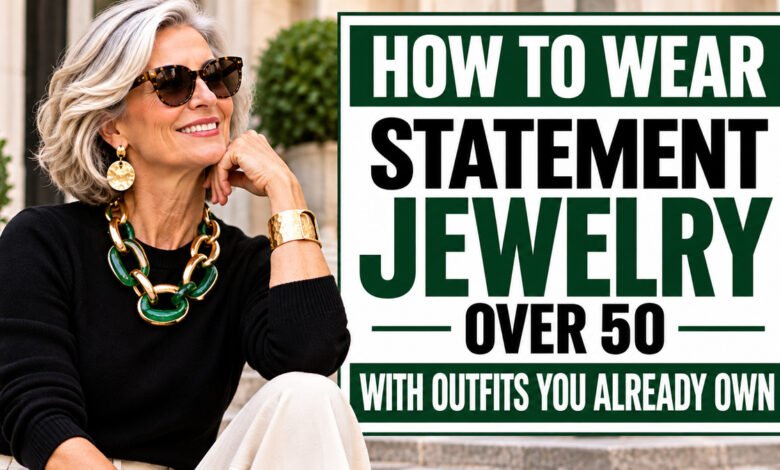
You put on your favorite black top and jeans. Everything fits, your shoes look good, but the outfit feels a little unfinished.
Then you add a necklace you’ve owned for years, and suddenly it looks like you made an effort.
That’s what good statement jewelry can do.
The interesting part is that the necklace doesn’t necessarily need to be expensive, particularly large, or covered in gemstones. Sometimes an unusual shape, a beautiful color, or an interesting texture is enough.
Still, figuring out how to wear statement jewelry over 50 isn’t always straightforward.
An oversized necklace might compete with your blouse. Dramatic earrings can feel uncomfortable after an hour. A bracelet that looks lovely at home may constantly catch against your handbag or jacket sleeve.
And many of us have accumulated jewelry over the years that we love individually but rarely wear because we aren’t quite sure what to pair it with.
Rather than collecting more accessories, let’s look at ways to make the pieces you already own work harder.
Start With the Outfit, Not the Jewelry Box
When getting dressed, it’s tempting to put on your favorite necklace first and then try to build an outfit around it. That can work for special occasions, but everyday styling is often easier the other way around.
Start with the clothes you’re planning to wear. Look at the neckline, fabric, color, and overall shape. Then consider what might make the outfit more interesting.
A plain crewneck sweater offers an excellent background for a pendant necklace. A shirt with an open collar creates space for a shorter chain. A patterned dress may need nothing more than a beautiful pair of earrings.
The accessory should have a reason to be there.
Outfit A: White cotton shirt, straight-leg jeans, and loafers. A sculptural gold necklace adds warmth near the face and makes the simple combination feel more intentional.
Outfit B: Black knit dress with an interesting neckline. Large earrings could be a better choice than a necklace, especially if the neckline already provides detail.
Outfit C: Beige trousers, a cream top, and a navy blazer. A colorful brooch or bold cuff can make the outfit feel personal without changing the classic clothing underneath.
The jewelry plays a different role in each outfit. Think about what the clothes need, rather than automatically reaching for the biggest accessory you own.
Match the Necklace to the Neckline
A beautiful necklace can look awkward when it sits at the wrong point on a top. Often, the issue isn’t its size or color. It’s where the necklace falls.
With a crewneck
Try a necklace that sits clearly above the neckline or hangs far enough below it to create separation. A chunky chain over a plain sweater can look wonderful. A necklace that falls exactly against the neckline may seem crowded, especially if the top is already textured.
With a V-neck
A pendant that sits comfortably within the open neckline is an easy choice. If you prefer something more architectural, a shorter chain or collar necklace can work. Avoid an awkward length where the pendant repeatedly disappears beneath the fabric.
With an open button-down
An open collar leaves room for a chain, short pendant, or interesting beads. There’s no need to open extra buttons if you prefer coverage. A necklace visible above the shirt opening can still make an impact. A white or pale-blue shirt is a lovely background for gold, silver, amber, coral, or turquoise-colored jewelry.
With a turtleneck
Longer necklaces can be especially useful. A pendant or beaded necklace worn over a smooth turtleneck creates a strong vertical detail. Choose enough length for the necklace to move naturally over the knit, and check that the metalwork doesn’t snag delicate fabric.
With a high-detail blouse
A ruffled collar, bow neckline, embroidery, or decorative buttons already bring attention to the upper body. Earrings or a bracelet may be easier than another major element at the neckline. There’s no rule against both; it simply takes experimentation.

Statement Earrings Can Be the Entire Outfit’s Finishing Touch
If you’ve ever worn distinctive earrings with a plain sweater, you know how much difference they make. They sit close to the face, remain visible when you’re wearing a jacket, and don’t have to compete with the shape of your trousers or skirt.
Sculptural metal earrings look striking with simple shirts, knits, and tailored jackets. Try irregular hoops, curved shapes, or hammered finishes.
Colorful earrings can brighten a neutral outfit. Deep green, cobalt, or burgundy earrings can make an ordinary white shirt feel different.
Pearl statement earrings offer an alternative to tiny studs. Baroque shapes, clustered pearls, or modern drops work with understated clothing.
Artistic earrings made from resin, wood, or mixed materials can look beautiful with denim, linen, and casual separates.
What if you wear glasses?
Pay attention to the combined effect of frames and earrings. Thick, colorful glasses already create a strong feature around your face. Substantial earrings in a simpler finish may work well, while understated frames leave room for unusual designs. Try both together in natural light. Also make sure your earrings don’t catch when you remove your glasses.
What about short hair or longer hairstyles?
With a pixie or bob, earrings are often especially visible. If you wear longer hair down, consider whether they remain visible or become tangled. A tuck behind one ear or a loose updo may be all you need. You shouldn’t have to change your hairstyle completely to enjoy your earrings.
Check the weight before committing
Large earrings aren’t necessarily heavy, and small ones aren’t always comfortable. A hollow metal design may be lighter than a compact stone earring. Wear a new pair around the house before choosing it for a wedding, dinner, or long event. If your ears begin to feel sore, they aren’t a good all-day choice.

A Bold Bracelet Can Be Better Than Another Necklace
Bracelets are sometimes overlooked when we talk about statement jewelry. A cuff or distinctive bangle can completely change an outfit, particularly when the neckline already has enough detail.
Imagine a white shirt with its sleeves rolled to the forearm, dark jeans, and a polished gold cuff. A wide silver cuff can look beautiful with a black knit dress or charcoal trousers. For softer outfits, try a resin bangle, smooth wooden bracelet, or a piece with interesting color.
Pay attention to sleeve length
A bracelet is most visible with three-quarter sleeves, rolled shirts, sleeveless tops, or relaxed cuffs. A large cuff underneath a close-fitting long sleeve may create an uncomfortable shape.
Think about your dominant hand
If you’re typing or using a mouse for much of the day, a rigid bracelet on your dominant wrist may become annoying. Try the opposite wrist. If you already wear a watch, decide whether a smaller bracelet or an alternative arm works better.
Rings can make a statement too
One sculptural ring can add personality without competing with your neckline. Before wearing it all day, make sure the setting doesn’t catch on clothing, handbags, or knitwear.

Don’t Forget Brooches, Pins, and Pieces You Inherited
Some of the most interesting statement jewelry isn’t new. It might be a brooch from your mother, a vintage pin from a secondhand shop, or something bought years ago and rarely worn.
A floral brooch on the lapel of a blazer is classic, but there are other options. Try a geometric pin near the collar of a plain shirt. Add a vintage brooch to a sturdy cardigan. Use a suitable pin to secure a scarf, provided the fabric and fastening can safely handle it. A sculptural brooch on a denim jacket can also make a traditional piece feel current.
Make the brooch feel modern
The garment you pair it with often determines the mood. A vintage floral brooch with a matching pearl necklace, formal blouse, and traditional jacket feels dressy. The same brooch on a dark denim jacket with a plain tee and modern trousers looks entirely different. Both can work.
Protect delicate fabrics
Before attaching a heavy pin, check the fabric. Fine silk, loosely knitted sweaters, and lightweight materials may snag, stretch, or develop visible holes. Choose a more substantial section and use appropriate support where necessary. Repair an heirloom’s loose fastening before wearing it outside.

How to Combine Statement Jewelry Without Looking Too Matched
Matching sets can be lovely, but wearing every piece from a set isn’t necessary. A necklace, earrings, bracelet, and ring can coordinate without identical stones, shapes, or finishes.
Repeat a color
If you’re wearing turquoise-colored earrings, choose a handbag, scarf, or patterned blouse containing a little of the same shade. It doesn’t have to match exactly.
Repeat a material
A sculptural gold necklace can work with smaller gold earrings even when the designs differ. Pearl earrings can look interesting with a smooth metal bracelet.
Repeat a shape
Rounded earrings may pair with a softly curved bracelet; geometric jewelry can work with tailored clothing. This can look more interesting than an exact matching set.
Can you wear gold and silver together?
Absolutely. Try a two-tone bracelet, a silver watch with gold earrings, or layered necklaces with different metal finishes. You don’t need to replace your existing jewelry just because you’ve started wearing more of one metal.
Seven Statement Jewelry Outfits You Can Try This Week
Instead of thinking about accessories separately, start with combinations you can recreate:
| Outfit | Statement piece | Why it works |
|---|---|---|
| White shirt, dark jeans, loafers | Sculptural gold necklace | Adds interest to familiar basics |
| Black knit dress, simple sandals | Colorful drop earrings | Brings attention near the face |
| Cream sweater, straight trousers | Long pendant necklace | Creates a vertical detail |
| Navy blazer, white tee, jeans | Vintage brooch | Makes classic tailoring personal |
| Linen shirt, beige trousers | Wide silver cuff | Adds texture to a quiet outfit |
| Printed midi dress, neutral shoes | Bold earrings in a print color | Connects the jewelry with the dress |
| Dark turtleneck, wide-leg trousers | Chunky beaded necklace | Gives the neckline a focal point |
These combinations don’t require an entirely new wardrobe. If a necklace feels too dramatic, try earrings. If you dislike bracelets, choose a ring or brooch.
What If You Love Wearing More Than One Bold Piece?
There’s no reason to limit yourself to one noticeable accessory if you enjoy an expressive look. The important question is whether the pieces feel connected.
Large gold earrings and a sculptural cuff can work because the repeated metal provides consistency while the space between the pieces allows both to be appreciated.
A chunky necklace and stacked bracelets can work with relatively simple clothing. Colorful earrings and a statement necklace can also coordinate through shared colors, shapes, or materials. Take a photograph of the whole outfit: it can help you see whether the accessories feel balanced from a distance. There isn’t a fixed number of pieces that makes an outfit stylish or excessive.
Buying Statement Jewelry: Five Checks That Save Money
1. Does it work with clothes I already own?
Think of at least three outfits you’d actually wear with the jewelry. If it only works with an imaginary future outfit, pause before purchasing.
2. Is it comfortable for more than ten minutes?
Try the clasp, move your arms, and turn your head if you’re wearing earrings. A necklace shouldn’t constantly twist, and a bracelet shouldn’t interfere with ordinary tasks.
3. Is the finish suitable for my skin?
If you react to certain metals, check the actual materials rather than vague labels such as “hypoallergenic.” Coatings can wear off and sensitivities vary.
4. Will it survive normal use?
Check for securely attached stones, stable clasps, smooth edges, and sturdy construction. Costume jewelry can be excellent, but low price isn’t a bargain if it breaks immediately.
5. Will I enjoy wearing it next year?
It’s fine to enjoy a trend. For a more expensive purchase, consider whether the piece suits your long-term style. Distinctive pieces with personal meaning often stay in rotation longer than accessories purchased for one trend.
How to Make Older Statement Jewelry Feel Current Again
Before buying something new, revisit the jewelry you have. A necklace that looked formal with a matching blouse may feel completely different against a plain black tee. Bold earrings reserved for parties might work with denim and a white shirt. An old brooch may become the interesting feature of a modern blazer.
- Replace a formal background with a casual one. Pair an embellished necklace with a plain knit instead of a dressy blouse.
- Separate matching sets. Wear the earrings with jeans and save the necklace for another outfit.
- Change the neckline. Try a pendant with a crewneck sweater instead of the blouse you normally pair with it.
- Wear an heirloom unexpectedly. A suitable vintage brooch can look striking on a structured denim jacket.
You may find the jewelry itself doesn’t need updating. Only the outfit around it does.
Jewelry Mistakes That Are Really Comfort Problems
Heavy earrings that make your ears sore aren’t suitable for long outings. A long necklace that catches against your handbag strap becomes frustrating. Noisy bangles may distract when you’re working, and rings with protruding settings can catch on delicate fabric.
These aren’t reasons to avoid statement jewelry. They’re reasons to choose pieces that fit your routine. For daytime, lighter earrings, smoother bracelets, and secure necklace lengths may be easier. For evenings, when you’re wearing different clothes and carrying less, you may enjoy something more dramatic.
A Simple Jewelry Wardrobe That Doesn’t Require Dozens of Pieces
If you’re starting from scratch, consider four accessory types:
- A distinctive necklace: something that works with favorite plain tops.
- A pair of statement earrings: lightweight enough for the occasions you have in mind.
- A bracelet or cuff: one that coordinates with everyday colors and doesn’t interfere with your routine.
- A personal piece: a brooch, unusual ring, vintage necklace, or something meaningful collected over time.
Prefer two pairs of earrings and no bracelets? That’s fine. The aim is choice, not another shopping obligation.
Frequently Asked Questions
What is the best statement jewelry for women over 50?
There isn’t one best type. Sculptural necklaces, colorful earrings, cuffs, brooches, and distinctive rings can all work beautifully. Choose based on your outfits, comfort needs, and personal style.
Can women over 50 wear big earrings?
Yes. Large earrings don’t have an age limit. Look for a pair that feels comfortable, suits your hairstyle, and works with your glasses if you wear them.
Should statement necklaces be worn with V-necks or crewnecks?
Both. With a V-neck, try a pendant within the opening. With a crewneck, choose a necklace that clearly sits above or below the neckline rather than awkwardly against its edge.
Can I wear a bold necklace and bold earrings together?
Yes. Try pieces that share a color, finish, or design characteristic. Simple clothing underneath can help, or you can embrace a more expressive outfit if that’s your preference.
How do I style statement jewelry for everyday casual outfits?
Start with jeans, a white shirt, a fine-knit sweater, or a simple dress. Add one interesting necklace, pair of earrings, cuff, or brooch.
Does statement jewelry have to be expensive?
No. Vintage finds, well-made costume jewelry, and affordable artisan designs can be great choices. Construction, comfort, and how the piece works with your wardrobe matter more than price.
Is it okay to mix gold and silver jewelry?
Yes. Mixing metals can look modern and intentional, particularly when shape, scale, or texture connects the pieces.
Final Thoughts
The best reason to wear statement jewelry is that it makes an outfit feel more like you.
Some days that might mean interesting earrings with a white shirt. Another day, it could be an inherited brooch on a blazer or a colorful necklace that makes a plain sweater special.
There’s no need to save every beautiful piece for a wedding or formal dinner, and there’s no age at which you have to stop enjoying bold accessories.
Look at the clothes you already love, experiment with different combinations, and pay attention to comfort. You may find that your best wardrobe update isn’t a new outfit at all—it’s a piece of jewelry that’s been waiting in your drawer for another chance to shine.